

When knee discomfort lingers after a meniscus injury, it can be hard to tell whether the problem is still healing, being irritated again and again, or needs a different approach. PRP for a meniscus tear is one option patients hear about when soreness, swelling, or reduced confidence in the joint continues after initial care.
At Integra Health Chiropractic Rehabilitation Wellness, we look at the type of meniscal damage, how the knee behaves during daily activity, and what has already been tried. Only then do we discuss whether platelet-rich plasma injections at our Hawthorne office belong in the conversation.
Why Don't All Meniscus Tears Heal the Same Way?
Healing depends a great deal on where the tear sits. The American Academy of Orthopaedic Surgeons explains that the outer one-third of the meniscus has a rich blood supply, so a tear there may heal on its own. The inner two-thirds lacks a significant blood supply, which limits healing in that zone.
The meniscus is a firm, crescent-shaped piece of fibrocartilage that helps distribute pressure inside the knee. Each knee has an inner and an outer meniscus, and both help absorb force during walking, bending, pivoting, and climbing stairs.
That uneven blood supply is one reason these injuries can be frustrating.
The pattern also counts. A sports-related twist can create a very different problem from gradual degenerative changes that develop over time. Tear location, size, joint health, age, arthritis, and the presence of locking or catching can all change the next step.
Persistent discomfort doesn't automatically mean the meniscus is still the only issue. Cartilage wear, muscle weakness, joint irritation, or altered mechanics can create similar complaints. When those factors lead, conservative care for a stiff, swollen knee may be the better starting point.
What Does PRP Add for a Torn Meniscus?
PRP, or platelet-rich plasma, is a concentrate made from a small sample of your own blood. Platelets contain growth factors and signaling proteins involved in the body's normal response to injury. For a meniscus tear, the concentrate is injected near the damaged area to support repair activity that is already under way.

The goal isn't to mechanically repair a tear or restore damaged cartilage to its original form. The idea is to introduce a concentrated sample of the patient's own platelets into a targeted area where biological repair activity is already taking place.
What the Research Shows So Far
The evidence is still developing. A 2024 systematic review in Arthroscopy, Sports Medicine, and Rehabilitation found that PRP injections for degenerative meniscus tears led to variable results. Pain and function scores improved in the studies it reviewed, while the clinical significance of those gains remains unclear.
A 2024 narrative review in Orthopedic Reviews reached a similar point. It describes PRP as an option when conventional treatment has not worked, with short-term benefits reported and long-term effectiveness still inconclusive.
At Integra Health, PRP is considered after the affected area has been assessed and the reason for ongoing symptoms is better understood. Results vary from person to person.
Which Meniscus Tears Is PRP Considered For?
PRP has been studied mostly for degenerative tears and for tears that keep causing symptoms after rest, exercise, or physical therapy. A knee that locks, or a tear with a displaced fragment, usually calls for an orthopedic opinion first. An MRI can show a tear, and the exam shows whether that tear is the main problem.
The image alone doesn't tell the full story. Two people can have similar findings and very different levels of pain or limitation.
Acute Tears
A sudden pivot, deep bend, or change of direction can damage the meniscus during sports or other physical activity. These cases may involve swelling, tenderness along the joint line, discomfort with twisting, or a catching sensation.
Certain tears can interfere with normal motion. If the knee locks or a displaced fragment is suspected, an orthopedic opinion may be more appropriate than an injection-first approach.
Degenerative Changes
Meniscal tissue can also fray gradually. This is more common when joint wear, osteoarthritis, or years of repeated stress are already present.
In that setting, the question becomes less about a single injury event and more about how the meniscus, cartilage, and surrounding structures are working together. The 2024 systematic review above focused on this group, including intrasubstance tears that stay inside the tissue.
Symptoms That Persist After Conservative Care
Some patients have already tried rest, exercise, physical therapy, or temporary activity changes. If discomfort returns once normal activity resumes, that history gives us useful information.
Mayo Clinic's sports medicine team describes non-operative meniscus care as starting with rest, ice, bracing, and physical therapy, with ultrasound-guided injections, including orthobiologics such as PRP, as the next level.
We want to know what improved, what stayed the same, and whether the knee still reacts to specific movements such as squatting, stairs, rotation, or longer periods of walking.
What Happens During a PRP Visit?
A PRP visit starts with a review of your knee history, any previous imaging, and treatment you have already tried. The joint may be checked for tenderness, motion, swelling, and stability. If PRP fits, the injection follows the preparation of your own blood sample.
The details still need to match the condition being treated. If the procedure is appropriate:
- A small blood sample is drawn.
- The sample is processed in a centrifuge.
- The platelet-rich portion is prepared for injection.
- Ultrasound guidance may be used when appropriate to help with placement.
- Local anesthetic can be used on the skin for comfort.
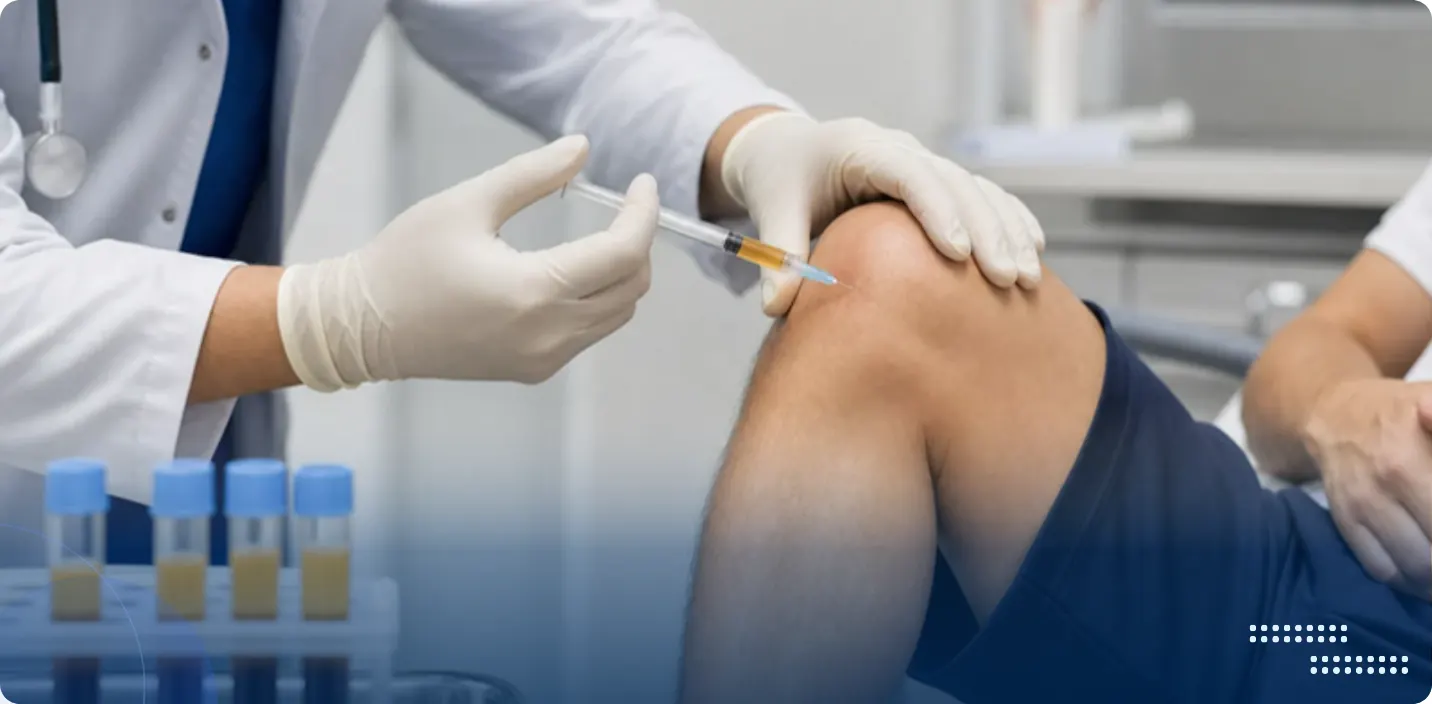
The material comes from your own blood, so no synthetic regenerative substance is being introduced into the joint.
The number of injections can vary. Some patients may be advised to complete more than one session, depending on the condition and how the knee responds over time.
What Does Recovery Look Like After PRP?
PRP doesn't work like a numbing medication, so the knee shouldn't be expected to feel dramatically different within a few hours. Mild soreness near the injection site can occur, and activity instructions depend on the structure treated, the extent of the problem, and your normal routine.
Heavy squats, running, court sports, or other high-demand activity may need to be limited for a period of time. The goal is to avoid repeatedly stressing the area while the biological response is developing.
Follow-up also gives us a chance to look at how the knee is handling everyday use, instead of judging the procedure only by what happens immediately after the injection.
When Is PRP Not the Right Choice?
PRP for a meniscus tear isn't appropriate for every case. Mechanical locking, significant instability, advanced joint damage, certain medical conditions, or an injury that needs surgical assessment can change the recommendation.
Another important question is whether the meniscus is actually the main source of the problem. Knee pain can come from several structures, and a regenerative procedure aimed at the wrong area is unlikely to be useful.
That's why the conversation starts with the clinical picture, and the procedure comes second.
Local PRP Care in Hawthorne
Integra Health is located at 153 Broadway Suite 1 in Hawthorne, near the Hawthorne Train Station and with access from the Saw Mill River Parkway and Taconic State Parkway.
We see patients from nearby communities, including Valhalla, Thornwood, Pleasantville, Mount Pleasant, Elmsford, and White Plains. Having follow-up close to home can make ongoing care easier to fit around work, exercise, or family schedules.
Deciding Whether PRP Fits a Persistent Meniscus Problem
A meniscus injury is more than a label on an MRI. The location of the damage, type of tear, presence of arthritis, mechanical symptoms, previous treatment, and day-to-day limitations all influence what makes sense next.
At Integra Health, we review those details before discussing regenerative options, and you can read about how our PRP program is planned and guided before your visit. If you're considering PRP for a meniscus tear, schedule an appointment to talk through your knee symptoms and find out whether this type of treatment fits your situation.
Frequently Asked Questions
Can a meniscus tear heal on its own?
Some can. The American Academy of Orthopaedic Surgeons notes that a tear in the outer one-third of the meniscus, where the blood supply is rich, may heal on its own. Tears in the inner two-thirds have limited blood flow and cannot heal on their own, so the location of the tear shapes the plan.
Who is not a good candidate for PRP for a meniscus tear?
A knee that locks, gives way, or shows significant instability usually needs a surgical assessment first. Advanced joint damage and certain medical conditions can also rule PRP out. The exam decides whether PRP fits.
How many PRP injections are needed for a meniscus tear?
The number varies. Some patients are advised to complete more than one session, depending on the condition and how the knee responds over time. Your provider sets the plan after the exam and reviews it at follow-up visits.
What are the downsides of PRP for a knee?
Mild soreness near the injection site can occur. Published research on meniscus tears shows variable results, so PRP may not help every knee. Some plans also call for more than one session.
How much does PRP for a meniscus tear cost?
The total depends on how many sessions your plan needs, whether ultrasound guidance is used, and your insurance picture. Most insurers classify PRP as elective, so ask for a complimentary benefits check before you book. Every patient receives a written cost breakdown at the consultation, before any treatment is scheduled.
Ready to take the next step?
Talk with the Integra Health team about a PRP Treatments plan built around your goals, in Hawthorne, NY.