Services
Chiropractic CareSpinal DecompressionDeep Tissue LaserShockwave TherapyPRP TreatmentsNeuropathy TreatmentSports ChiropractorMassage TherapyNutrition CoachingPediatric CarePre & Postnatal CareAll ServicesConditions
Back PainNeck PainSciaticaShoulder InjuryKnee PainHip PainPlantar FasciitisAuto Accident InjuryWhiplashAreas Served
HawthorneMount PleasantWhite PlainsMount KiscoArmonkPleasantvilleChappaquaBriarcliff ManorTarrytownElmsfordValhallaThornwood


Conditions Shockwave Therapy Treats Across Westchester
Shockwave shines where healing has stalled: the heel pain that outlasted new sneakers, the elbow that flares with every grip, the hip that aches on stairs. It is often the missing piece for plantar fasciitis, chronic knee tendon pain, and stubborn shoulder problems. The full clinical rundown lives on our shockwave therapy page.
| Condition | Where It Shows Up | How Shockwave Helps |
|---|---|---|
| Plantar fasciitis | Sharp heel pain with the first steps of the morning | Breaks down scar tissue and stimulates fresh blood flow so the fascia can remodel |
| Achilles and patellar tendinopathy | Aching above the heel or below the kneecap when running and jumping | Triggers new blood vessel growth in zones with naturally poor circulation |
| Tennis and golfer's elbow | Burning at the outer or inner elbow with gripping and lifting | Restarts a stalled healing response inside degenerated tendon fibers |
| Calcific shoulder tendinitis | Sharp, catching pain when reaching overhead | Helps fragment calcium deposits while calming surrounding inflammation |
| Hip bursitis and gluteal tendinopathy | Outer-hip ache on stairs or lying on that side | Reaches deep lateral hip tissue hands-on care struggles to change |
| Chronic muscle trigger points | Stubborn knots in the calf, glutes, or shoulder blade region | Disrupts the contracted tissue and its referral pain cycle |
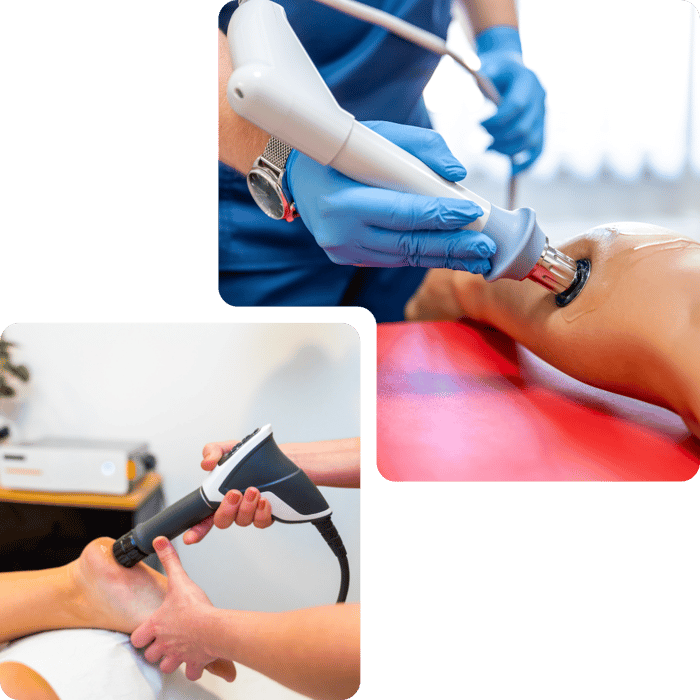
Can Shockwave Heal Tendonitis (Tendinitis) and Ligament Injuries?
It can help both heal, with a distinction. Tendonitis, also spelled tendinitis, is where the research is deepest, especially Achilles, patellar, elbow, and calcific shoulder problems that have lingered for months. A fresh, hot tendon injury usually needs rest and load changes first.
Ligaments are built from similar collagen with the same limited blood supply. By stimulating circulation and collagen production, acoustic waves can nudge a chronically irritated ligament, like an ankle sprain that still aches months later, back into an active healing state. For the general medical picture, the National Institute of Arthritis and Musculoskeletal and Skin Diseases explains how tendon problems are understood.
What it will not do is reconnect a fully torn tendon or ligament; when an exam points that way, we refer you for a surgical opinion.
Shockwave vs. Cortisone vs. PRP vs. Surgery: An Honest Comparison
The right choice depends on your tissue, your timeline, and how long the problem has existed. Several options, including PRP treatments, are available in our own clinic, so the recommendation you get is based on fit, not on what we happen to offer.
| Shockwave Therapy | Cortisone Injection | PRP Injection | Surgery | |
|---|---|---|---|---|
| How it works | Acoustic waves stimulate your body's own repair response | Steroid medication suppresses inflammation and pain signals | Concentrated platelets from your own blood deliver growth factors | Structural repair or removal of the damaged tissue |
| Invasiveness | Non-invasive, applied through the skin | Needle injection | Blood draw plus a guided injection | Operative procedure with anesthesia |
| Downtime | None beyond easing off high-impact activity briefly | Minimal; activity is often limited briefly | Short; soreness for several days is common | Weeks to months of restricted activity and rehab |
| Typical course | Commonly 3 to 5 weekly sessions | A single shot; repeats are limited because tissue can weaken | Often a short series spaced weeks apart | One procedure plus a structured rehab program |
| Best suited for | Chronic tendon and soft tissue problems that stalled | Short-term relief of an acutely inflamed joint or tendon sheath | Injuries that need a stronger biological push toward repair | Full tears and structural damage conservative care cannot fix |
Is There a Downside to Shockwave Therapy?
The sensation is intense for some patients, though it is dialed to your tolerance, and mild soreness, redness, or light bruising can follow for a day or two. It is not a one-visit miracle either: tissue remodels on its own schedule, so improvement builds over weeks.
It is also not right for everyone, and the section below lists who should skip it. When the exam says shockwave is the wrong tool, we tell you plainly and point you toward a better one.
Who Should Not Get Shockwave Therapy
Shockwave is avoided during pregnancy near the abdomen or low back, near a pacemaker or implanted device, over an active infection or tumor, and over open growth plates in children. A bleeding disorder, blood thinners, or a recent steroid injection in the same spot calls for extra caution.
The screening questions at your first visit exist to catch these cases before any treatment starts, whether you come from White Plains, Mount Kisco, or down the road in Hawthorne.
Usually a good fit
Not a fit, or not yet
This list is general guidance rather than personal medical advice, so confirm your own suitability with the clinician at your exam and tell us about every device, medication, and diagnosis.
Shockwave Therapy Questions We Hear Across Westchester
Who should not have shockwave therapy?+
Shockwave is usually avoided during pregnancy near the abdomen or low back, near a pacemaker or other implanted device, over an active infection or tumor, and over open growth plates in children. A bleeding disorder, blood thinners, or a recent steroid injection in the same spot also calls for caution. Your clinician confirms suitability at the exam before any treatment.
Can shockwave heal tendonitis?+
It can help restart healing in chronic tendonitis, also spelled tendinitis, when the problem has stalled for months, such as Achilles, patellar, elbow, or calcific shoulder trouble. That is where shockwave research is deepest. A fresh, acutely inflamed tendon usually needs rest and load changes first, and a fully torn tendon needs a surgical opinion rather than shockwave.
Is shockwave therapy worth the money?+
It is worth it when the problem fits and simpler steps have genuinely been tried. For a heel or tendon problem that outlasted rest, stretching, and new shoes, a short series is a reasonable non-invasive step before injections or a surgical consult. For a fresh strain that will settle on its own, it is not worth it, and we will tell you so.
What does shockwave therapy cost?+
Shockwave is billed by the session, so the main factor is how many sessions the tissue needs, which depends on the area treated and how long the problem has been there. Whether it runs alongside other care, and what your plan covers, also matter. See how coverage and costs are worked out.
Does insurance cover shockwave therapy in New York?+
Coverage varies widely, and many plans classify shockwave as elective. We run a complimentary benefits check before your first session so you know where your plan stands, and we offer transparent self-pay and package options when coverage falls short. You hear all of that before the first session, not after it.
How many sessions does shockwave therapy take?+
A short series, commonly 3 to 5 sessions spaced about a week apart, is typical. Chronic, long-standing problems sometimes need more. We track your response session by session instead of locking you into an arbitrary number, and we tell you if progress stalls.
Do you use radial or focused shockwave?+
Radial spreads energy across broader, shallower tissue, while focused drives it to a precise depth. Both are established forms of musculoskeletal shockwave, and the right choice depends on how deep the problem tissue sits. At your evaluation we walk you through the device, the settings, and why they fit your condition.
Does shockwave help piriformis syndrome?+
It can. The piriformis is a deep gluteal muscle, and shockwave reaches depths that hands and foam rollers cannot, releasing the contracted tissue that irritates the sciatic nerve. We confirm the diagnosis first, since disc-related sciatica needs a different approach.