
Tendon injuries have a frustrating personality. They improve with rest, then return the moment you resume the activity that caused them. Months pass. The elbow, heel, or shoulder never fully resolves and never gets bad enough to force a decision.
That pattern is different from a joint problem or a muscle strain, and it is worth understanding on its own terms, because the reason tendons stall is specific to how tendon tissue is built.
Why Tendons Heal Slowly
Tendons connect muscle to bone and transmit force. They are dense, highly organized collagen, and compared with muscle they receive relatively little blood flow. Less circulation means fewer of the cells and signaling factors that drive repair reach the tissue.
When a tendon is repeatedly overloaded, small-scale damage accumulates faster than the tissue rebuilds. Tendinitis and related tendon problems frequently develop from that repetition rather than a single injury, which is why the onset is often hard to pinpoint.
The result is a tendon that is structurally compromised, still generating pain signals, and stuck partway through a repair process that has effectively stalled. Rest reduces the load but does not restart the process.
Where PRP Fits
Platelet-rich plasma concentrates the platelets from a sample of your own blood. Platelets carry growth factors that coordinate tissue repair, and delivering them directly into a stalled area is intended to restart a healing response that has gone quiet.
That mechanism lines up specifically with the tendon problem described above. Where a tendon is not healing because the biological signal is not reaching it in sufficient concentration, adding that signal is a reasonable thing to try.
This is also why PRP for tendons is discussed differently than PRP for joint arthritis. The tissue, the goal, and the expected timeline are not the same. The published research on platelet-rich plasma in tendinopathy is active and worth reviewing, and it is fair to say results vary by tendon, by preparation, and by how the injection is combined with loading afterward.
The Tendon Problems This Comes Up For
Tennis Elbow and Golfer's Elbow
Pain on the outside or inside of the elbow that worsens with gripping, lifting, or repeated wrist motion. Elbow tendon problems are among the most common overuse presentations, and among the most likely to linger for a year or more when the aggravating activity is occupational rather than recreational.
Achilles and Heel Pain
The Achilles and the plantar fascia both tolerate enormous repeated load and both are slow to recover once irritated. Heel pain has several distinct causes, which is why the assessment matters before choosing a treatment. If your symptoms center on the underside of the heel, our page on heel pain from plantar fasciitis covers that presentation specifically.
Rotator Cuff Strain
Cuff tendons irritated by repeated overhead work or a training spike. Often accompanied by weakness with lifting and discomfort sleeping on the affected side.
Injuries That Have Not Responded to Rest
The general category, and the most common reason patients ask about PRP. Something has been managed conservatively for months without resolving, and the question is what to try before considering surgical options.
What the Treatment Involves
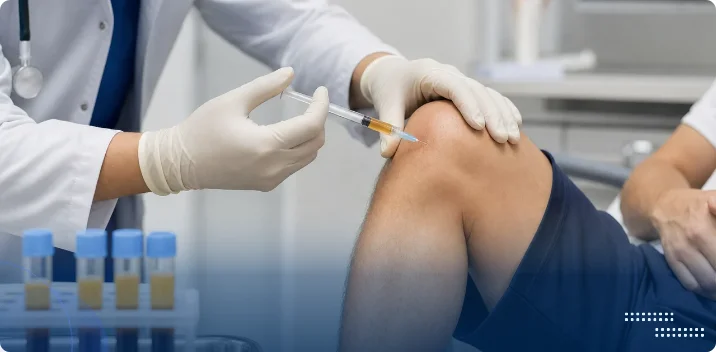
A small blood sample is drawn and processed in a centrifuge to separate and concentrate the platelet-rich portion. That concentrate is then injected into the target area using a thin needle.
Most patients feel pressure or brief discomfort during the injection. The procedure is minimally invasive and typically completed in a single visit. Your provider should explain what is being targeted and why that location was chosen.
The Part That Matters More Than the Injection
PRP is not a standalone event, and treating it as one is the most common way it underdelivers.
Tendons remodel in response to load. An injection that restarts a repair response still needs appropriate loading afterward to rebuild tissue that can tolerate your actual activity. A plan should include movement guidance to protect the area early, a graded return to loading, activity modification while tissue recovers, and clear markers for what progress should look like.
Expect a series of treatments rather than a single one, and expect improvement to develop over weeks. Tendon tissue does not remodel quickly, and a timeline that sounds too fast is a reason to ask more questions.
When to Consider It
It may be worth a conversation if you have a tendon injury that is slow to heal despite rest, pain that returns every time you resume activity, stiffness limiting daily or athletic function, chronic soft tissue pain that has not responded to conservative care, or an interest in exploring regenerative options before considering surgery.
You do not need to wait for symptoms to become severe. Tendon problems addressed earlier generally require less time than ones managed around for a year.
How the Assessment Works
The first appointment starts with a conversation about symptoms, health history, and daily demands, including when the pain started and what makes it better or worse.
A physical assessment follows, evaluating the affected area and range of motion to determine whether PRP is an appropriate option for your condition. Sometimes it is not, and that answer should come with an explanation of what would fit better.
PRP is also designed to work alongside the practice's other services. Depending on your situation a plan may combine injections with manual care, corrective exercise, or other supportive therapy, which tends to produce more durable outcomes than any single treatment alone. You can review the platelet-rich plasma treatment options available at our Hawthorne office for more on how this is delivered.
Local Care in Hawthorne
Integra Health is located at 153 Broadway Suite 1 in Hawthorne, near the Hawthorne Train Station. Patients also come from Valhalla, Thornwood, Pleasantville, Mount Pleasant, Elmsford, and White Plains, with access from the Saw Mill River Parkway, Taconic State Parkway, and Route 287.
Tendon recovery runs on reassessment more than most care does, since the loading plan changes as tissue tolerance improves. Being able to get back in for those checkpoints is part of what makes the plan work.
A Clear Next Step
Tendon injuries that have not resolved on their own are rarely a matter of needing more rest. They usually reflect tissue that has stalled partway through repair and needs both a biological stimulus and a structured return to load.
If you have been managing a stubborn elbow, heel, or shoulder for months, schedule an assessment to find out whether PRP fits your situation and what a realistic timeline would look like.
Ready to take the next step?
Talk with the Integra Health team about a PRP Treatments plan built around your goals, in Hawthorne, NY.