
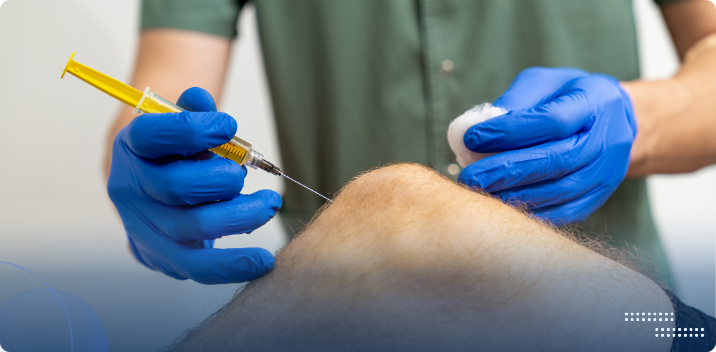
PRP treatments for joint pain give you another option when stiff, aching joints start to control your day. You bend to tie your shoe, and your knee protests. You reach for the top shelf, and your shoulder feels stuck.
Joint pain turns small, everyday movements into careful calculations. Many people assume their only choices are medication or surgery, yet there is another path that focuses on your body's own repair. PRP therapy uses your own blood platelets to help reduce pain, support healing, and help you feel more natural again.
What Is PRP Treatment?
PRP treatment uses concentrated platelets from your own blood to deliver growth factors and healing proteins directly into damaged joints. The technology takes advantage of your body's natural repair system by concentrating the cells responsible for tissue healing and delivering them exactly where they're needed most.
During treatment, a small amount of your blood is drawn and processed in a centrifuge to separate and concentrate the platelets. These platelets are then carefully injected into the injured or painful joint. There are no synthetic chemicals and no foreign substances. The goal is to jump-start your body's natural healing response and give damaged tissue the resources it needs to repair itself.
For people living with osteoarthritis, tendon injuries, or long-standing joint pain, PRP therapy offers a way to focus care on the joint itself instead of only masking symptoms.
How PRP Treatment Works for Joint Pain
Joint damage changes how a joint moves and feels over time. The cartilage can thin, the surrounding tendons weaken, and the joint lining becomes more sensitive. PRP therapy delivers concentrated growth factors directly to that area so the body can mount a stronger, more organized repair response.
In simple terms, PRP treatment may help:
-
Stimulate the growth of new, healthy tissue in damaged cartilage and tendons.
-
Reduce inflammation by modulating the body's immune response in the joint.
-
Improve the quality and strength of healing tissue rather than scar tissue.
What changes is the environment inside the joint. When the tissues receive the biological signals they need to heal properly, everyday movements can feel easier and less guarded.
PRP therapy offers a way to focus care on the joint itself instead of only masking symptoms.

Benefits of PRP Treatment for Joint Pain Patients
If you have tried heat, rest, or basic stretching and your joint still complains each morning, PRP therapy may offer something different.
Pain Relief That Lasts
Many patients report significant drops in pain that continue to improve over several months as healing progresses. Because the therapy addresses the underlying tissue damage, relief can last longer than injections that only reduce inflammation temporarily.
Better Joint Function
When damaged tissue begins to repair and inflammation decreases, your range of motion often improves. Is that stiff knee still making it a challenge to climb stairs? It may strengthen enough to let you move with less hesitation.
Using Your Own Biology
PRP comes from your own blood, processed and returned to your body in the same visit. You're not introducing foreign substances or worrying about rejection or allergic reactions.
A Complement to Rehabilitative Care
PRP therapy pairs well with physical therapy and chiropractic care. As pain decreases and tissue heals, you can push harder in rehab exercises, building strength and stability around the joint.
Joint Pain Relief That Fits Real Life
Integra Health uses PRP therapy to support natural healing in damaged joints so you can get through your day with more comfort and confidence.
[Start Your Recovery Today]
What to Expect During Treatment
A typical visit starts with a conversation about which joints bother you most and what activities are hardest right now. A small amount of blood is drawn from your arm, similar to routine lab work. That blood is then placed in a centrifuge for several minutes to concentrate the platelets.
Treatment sessions at Integra Health involve a careful injection of your concentrated platelets directly into the affected joint, and the entire process is tailored to your condition and comfort. The injection itself takes just a few minutes. Local anesthetic may be used to minimize discomfort during the injection.
After treatment, you may be asked to limit intense activity for a day or two to let the platelets settle and begin their work. Most people return to light daily activity fairly quickly, though some temporary soreness at the injection site is common.
Many joint pain care plans include one to three PRP sessions, often spaced about four to six weeks apart. Your provider will set the schedule based on how your joints respond and what you want to get back to doing.
PRP Treatment for Joint Pain at Integra Health
At Integra Health, PRP therapy is a core option for people who want joint pain relief without jumping straight to surgery or long-term medication. The team uses your body's own healing factors to repair damaged joints, improve comfort, and help you move with more confidence in daily life.
During your visit, your provider looks at which joints hurt most and how that pain shows up in your routine, from walking and stairs to work and sleep. A PRP plan is then built around your priorities.
PRP therapy can be used on its own or paired with chiropractic care and physical therapy when extra support is needed. The goal is simple: give your joints the biological tools they need to heal so they can handle real life with less pain and more freedom to move.
Who Is a Good Candidate for PRP Treatment?
PRP therapy can help many people with osteoarthritis in weight-bearing joints like the knees, hips, and lower back, as well as joints in the shoulders or other areas affected by tendon injuries or overuse.
You might be a good fit if:
-
Joint pain or stiffness makes everyday tasks feel harder than they used to.
-
You want to try regenerative, non-surgical options before considering more invasive procedures.
-
You have tried basic conservative care and feel stuck at the same level of discomfort.
Your provider will review your medical history, current medications, and any imaging you have had. They will also consider your overall health and goals to decide if PRP therapy makes sense as part of your joint pain care plan.

Choosing Your Next Step
PRP treatment for joint pain is not a magic reset button for worn joints, yet it can be a powerful way to ease pain, reduce inflammation, and support your body's natural repair. When concentrated platelets are injected into damaged joints with a clear plan, the tissue often responds with better healing, less irritation, and a smoother feel when you move.
If you live in or near New York and joint pain has you turning down invitations or planning your day around good hours and bad hours, the team at Integra Health is ready to help. We combine PRP therapy, chiropractic care, and physical therapy to create personalized plans that focus on what you want to do, not just what hurts.
Reach out today to find out whether this treatment fits your joints, your lifestyle, and your next steps toward a more comfortable, active life.
Ready to take the next step?
Talk with the Integra Health team about a PRP Treatments plan built around your goals, in Hawthorne, NY.