

For adults dealing with shoulder pain that keeps coming back, the source isn't always limited to the sore joint. Upper back stiffness can play a part. Your upper back helps position the shoulder blade each time you raise an arm, reach across your body, or rotate to grab something behind you.
If the thoracic spine is stiff, those mechanics can change and place different demands on nearby tissues. At Integra Health Chiropractic Rehabilitation Wellness, our shoulder injury evaluation and rotator cuff care looks at the upper back, neck, shoulder blade, and the joint itself. Treatment then follows the findings.
How do the upper back and shoulder work together?
The shoulder blade glides on the rib cage, and the upper back has to extend and rotate for the arm to rise fully. When the upper back is stiff, the shoulder may end up doing more than its share of the work.
The shoulder blade, or scapula, rests against the rib cage without a traditional joint holding it there. Muscles around the chest and upper back control its position while the arm moves.
As you raise your arm, the scapula rotates and changes its angle against the ribs. The thoracic spine also contributes through extension and rotation. That coordination helps the arm reach higher without relying on the glenohumeral joint alone.
A stiff upper back can alter that relationship. Someone may still be able to reach overhead, but the body might borrow motion from the neck, lower back, or shoulder itself. Repeating that pattern during lifting, sports, or a long workday can make an already sensitive area harder to settle.
Which upper-back areas affect the shoulder?
Three areas matter most: thoracic extension, the way the shoulder blade moves, and mobility through the neck and ribs. Shoulder symptoms don't automatically point to a thoracic problem. Checking each one shows whether the upper back is actually involved.
Thoracic Extension
Thoracic extension is the ability to straighten through the middle and upper spine. You use it when reaching into a high cabinet, pressing a weight overhead, serving a tennis ball, or swinging a golf club.
If that range is limited, you might compensate by arching the lower back or moving the head forward. Watching how the body completes the task can reveal restrictions that aren't obvious when you're sitting still.
Scapular Motion
The shoulder blade needs to rotate, tilt, and glide as the arm rises. Muscles including the trapezius and serratus anterior help control that motion.
Upper-back stiffness can affect the position and movement of the scapula during reaching or overhead activity. When that happens, the shoulder may need to work harder to complete the same motion, which can increase strain in an already sensitive area.
UT Southwestern Medical Center describes scapular dyskinesis, an abnormal position of the shoulder blade during movement, as one cause of upper back pain. That link is one reason the shoulder blade gets a close look during an exam.
Neck and Rib Mobility
The cervical and thoracic regions work closely together. Stiffness around the ribs or upper spine can influence how comfortable it feels to rotate, reach, or take the arm overhead.
The neck also deserves attention. MedlinePlus explains that shoulder pain can start in another area, such as the neck, a pattern called referred pain. Identifying where symptoms originate helps avoid focusing treatment on the wrong area.
What clues point beyond the shoulder?
How symptoms behave often says more than where they hurt. Certain patterns during everyday tasks suggest the upper back or neck may be involved.
Signs worth discussing include:
- Tightness between the shoulder blades after prolonged desk work
- Difficulty reaching overhead without arching the back
- A noticeable difference between the right and left sides
- Neck stiffness that appears with arm discomfort
- Pinching during pressing, throwing, or overhead activity
- Reduced upper-back rotation during golf, tennis, or exercise
These patterns aren't a diagnosis. Rotator cuff problems, bursitis, arthritis, acute injuries, and other conditions can produce similar complaints, which is why an exam comes first.
Get emergency care first: The National Heart, Lung, and Blood Institute lists pain in the back, shoulders, neck, jaw or arms among the warning signs of a heart attack. If shoulder or upper back pain comes on suddenly with chest pressure, shortness of breath or sweating, call 911 right away.
Can chiropractic adjustments help?
They can help when the exam finds restricted motion in the upper back, neck, ribs, or an extremity joint that is changing how the arm moves. Research on thoracic manual therapy for shoulder pain is encouraging in the short term, though still limited, so adjustments are one part of a plan.
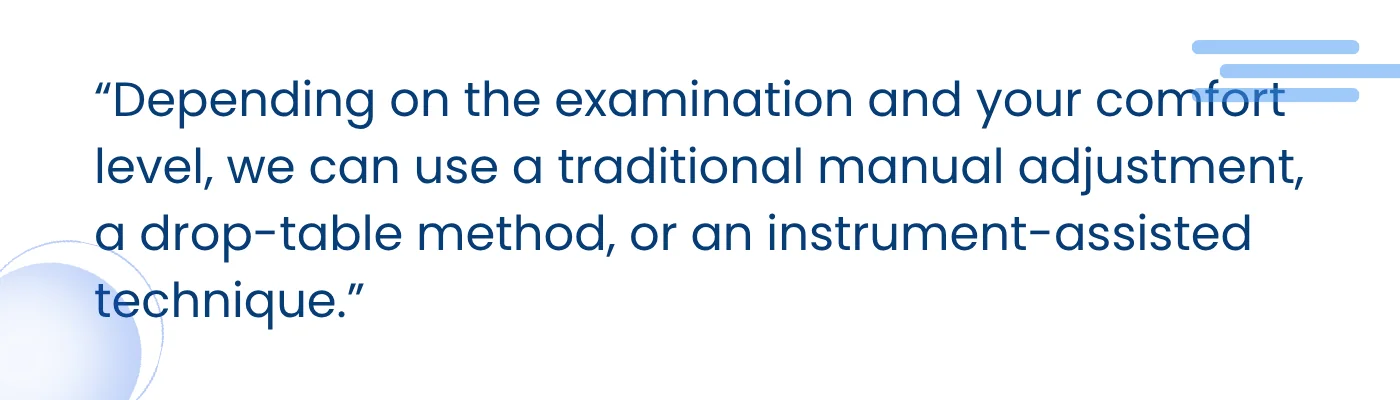
Our adjustments don't follow one preset technique. The method depends on the examination and your comfort level.
A 2025 systematic review found that thoracic manual therapy reduced pain and disability in subacromial pain syndrome, mostly in the short term. That syndrome is a common cause of shoulder pain when lifting the arm. An earlier review found limited evidence for thoracic spine manipulation in shoulder conditions and called for more research.
For shoulder pain, the relevant question is whether a restriction elsewhere is changing how the arm moves. If the upper back has normal mobility and the findings point to a local injury, adjusting the thoracic spine simply because it's nearby wouldn't address that issue.
Exercises or changes to daily habits can also be useful when stiffness has developed alongside repeated positions at work, during training, or while driving.
What do we check during your visit?
The visit pairs a conversation about your history with hands-on testing of the shoulder, upper back and neck. The goal is to find which area is driving the symptoms before choosing a treatment.
We start by asking when the symptoms began, which motions bring them on, and whether work, sleep, exercise, or a previous injury has changed how the area feels.
The examination can include shoulder range of motion, upper-back mobility, neck movement, strength, posture, and shoulder blade mechanics. When appropriate, we may also use focused orthopedic or neurological testing and review any imaging you bring to the appointment.
For example, we may look at whether changes in upper-back position affect how comfortably the arm rises or rotates. We'll explain what we find in clear terms and use those findings to decide whether a chiropractic adjustment or another approach makes sense.
Chiropractic Care Close to Home in Hawthorne
Our office is at 153 Broadway Suite 1, near the Hawthorne Train Station. We're also a short drive from Westchester Medical Center and near Rose Hill Shopping Center.
That location can be practical for people coming from Valhalla, Thornwood, Pleasantville, White Plains, or other parts of Mount Pleasant. Free parking is available directly in front of the building.
Putting Shoulder Pain in Context
Upper back stiffness can affect how the shoulder blade and arm move, particularly during reaching, lifting, and overhead activity. Still, the connection has to be assessed rather than assumed. A rotator cuff injury, local joint problem, cervical involvement, or another issue can produce a different clinical picture.
If desk work keeps tightening your upper back, our shoulder care that also checks thoracic spine mobility looks beyond the sore spot.
At Integra Health, we look at those distinctions before recommending treatment. If shoulder pain keeps returning or has started limiting daily activity, schedule an appointment so we can examine the area and discuss which options fit the findings.
Frequently Asked Questions
When should upper back and shoulder pain be checked right away?
Call 911 for sudden shoulder or upper back pain with chest pressure, shortness of breath, sweating, or pain spreading to the jaw or arm. MedlinePlus gives the same 911 advice for sudden, crushing shoulder pain. A severe injury that leaves the shoulder very swollen or bruised needs the emergency room.
Can a neck problem cause shoulder pain?
Yes. Irritation in the neck can send pain into the shoulder or upper arm, a pattern known as referred pain. That's why a shoulder exam should include the neck. If neck movement brings on the shoulder symptoms, the plan may need to address the neck too.
Why do I get pain between my shoulder blades after desk work?
Long hours in one seated position, often with the head drifting forward, can leave the upper back stiff and tired. UT Southwestern Medical Center reports seeing more upper back pain tied to posture as more people began working remotely. If the ache keeps returning, an exam can check upper-back and shoulder blade motion.
Can a chiropractor help upper back and shoulder pain?
It depends on what the exam finds. When restricted motion in the upper back, ribs or neck is changing how the shoulder moves, adjustments combined with exercises and habit changes may help. Research reviews report short-term gains from thoracic manual therapy for some shoulder conditions, though the evidence is still limited.
Why does my shoulder hurt more when I reach overhead?
Reaching overhead asks the upper back to extend and the shoulder blade to rotate upward. If either motion is limited, the shoulder joint may take on more strain at the top of the reach. MedlinePlus names rotator cuff tendinitis and bursitis as the most common cause of shoulder pain, so the source can't be confirmed without an exam.
Ready to take the next step?
Talk with the Integra Health team about a Shoulder Injury Care plan built around your goals, in Hawthorne, NY.